After 10 years of waiting, the SEC finally approved 11 spot bitcoin ETFs in 2024. This post covers all you need to know on how to choose the best bitcoin ETF.
Before spot bitcoin ETFs appeared, only bitcoin futures ETFs were available for investing. Sadly, they were very expensive and subject to time decay from derivatives. For instance, take a look at Grayscale Bitcoin Trust (GBTC). The fund used bitcoin futures before January 11, 2024.

We see that it had major deviations from the bitcoin price.
Factors to Consider for Spot Bitcoin ETFs
While all 11 bitcoin ETFs hold the same asset, that is bitcoin, not all of them are created equal. There are 4 factors that any investor should consider.
1. Expense Ratios of Bitcoin ETFs
The first factor to consider for the best bitcoin ETF is the expense ratio. If you are a buy-and-hold investor, focusing on fees is crucial. Here is a table that summarizes the expense ratios for 11 bitcoin ETFs.
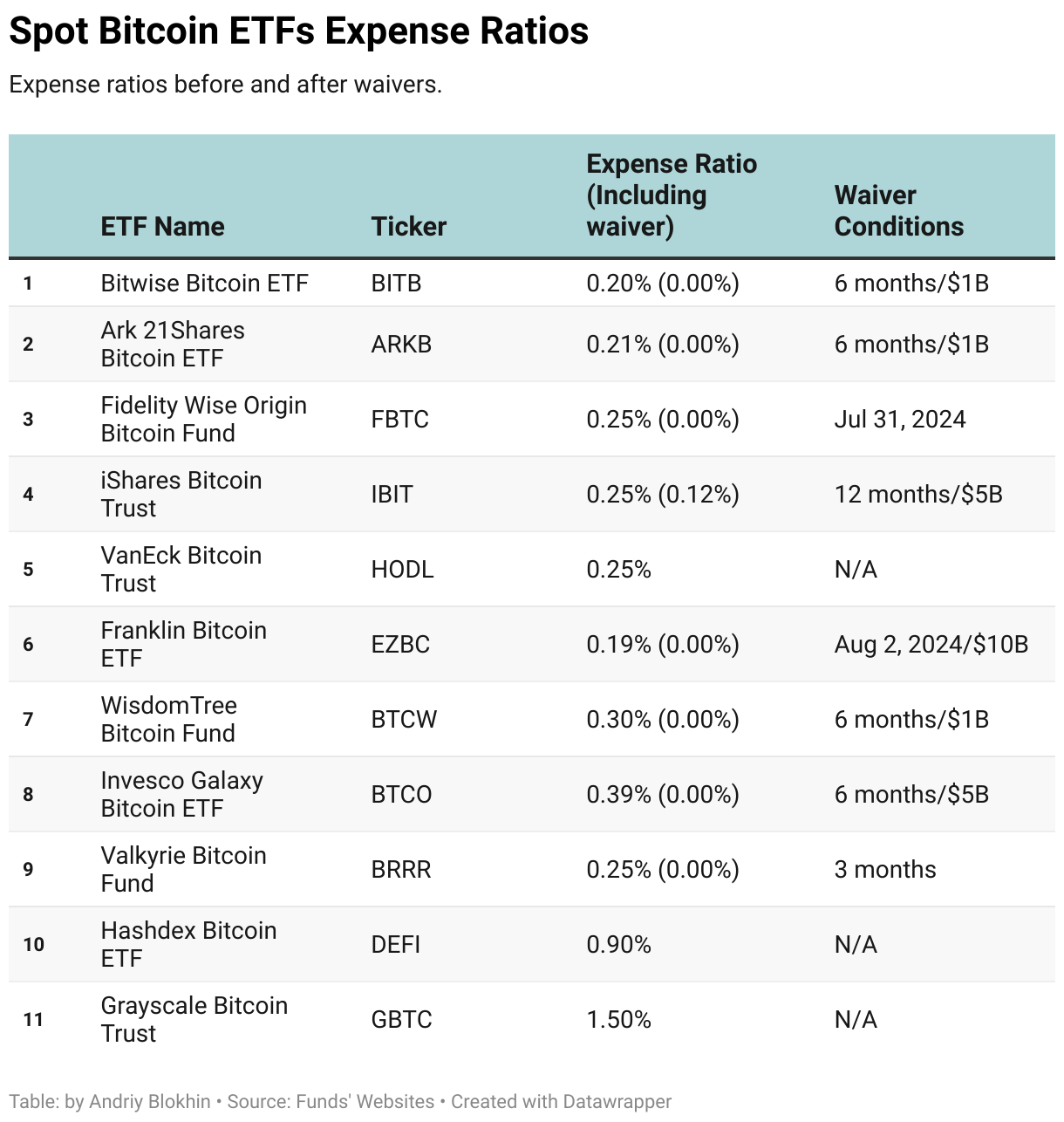
I show these expense ratios before and after waivers in parentheses. Because these funds are still building momentum, they provide temporary incentive for investors to buy in. Many of them waive fees with limitations. Such limitations include a certain period of time or until a fund reaches an asset threshold.
The Franklin Bitcoin ETF (EZBC) offers the lowest expense ratio of 0.19% before waivers. Seven other bitcoin ETFs charge expense ratios within a 0.10% deviation. Moreover, many funds waived their fees. For instance, EZBC waived fees to 0% until August 2, 2024 or before the fund reaches $10 billion in assets.
Not all bitcoin funds provide such waivers, of course. The most expensive fund is the incumbent Grayscale Bitcoin Trust (GBTC). Before 2024, GBTC charged 2%. But, with the SEC’s approval, Grayscale converted GBTC to a spot bitcoin ETF in January and lowered its fee to 1.50%.
For now, GBTC is one of the largest funds with about $29 billion in assets. But, most of these assets are legacy money that flowed in when no spot Bitcoin ETFs were available. So, things may change fast for Grayscale with competition. Very likely, GBTC will have to lower again its fees to match its rivals.
2. Liquidity of Spot Bitcoin ETFs
Liquidity is another consideration for the choice of best bitcoin ETF. It is especially important for actively-trading investors. By liquidity I mean how fast you can trade ETF shares without a material impact on the price. You want to buy a spot bitcoin ETF with a relatively large trading volume and a low bid-ask spread.
One metric to focus on is the bid-ask spread percent. You calculate it as the dollar spread (ask minus bid) divided by the average of bid and ask. The lower the spread percent is, the better price you will get.
Most ETFs must disclose a 30-day median bid/ask spread percent on their websites. Of course, only a few trading days passed by since spot bitcoin ETFs got approved. Still, I compiled this metric across these 11 funds.

As we see, the spread percent across funds is quite tight. However, iShares has a noticeable lead. Grayscale ETF has the worst spread percent of them all. But, this reflects bid-ask spreads before its conversion to a spot bitcoin fund. So, most likely GBTC’s spreads will improve going forward.
Other metrics that can signal high liquidity are trading volume and dollar volume. The dollar volume is a product of share price and trading volume. Ideally, we should use averages for the past several months.
Looking at the table, we see that Grayscale leads the pack. But again, this probably reflects its legacy. Other notable funds with large volumes include iShares, Fidelity and Bitwise.
3. Net Asset Sizes for Bitcoin ETFs
Also, you can assess bitcoin ETFs by their net asset sizes. The bigger the size is, the more likelihood there is that the funds will stick around. Sadly, it is too early to assess this metric for the best bitcoin ETF.

While I compiled net asset positions for each spot bitcoin ETF, these numbers are in flux. Grayscale aside, we see that Bitwise, iShares and VanEck had a good start.
4. Trading Costs for a Best Bitcoin ETF
The final factor in settling on the best spot bitcoin ETF is the trading cost that a fund incurs. You may know that a typical ETF creates shares through in-kind transactions.

This means that an ETF itself is not responsible for trading expenses. Another intermediary, usually a broker-dealer, assembles underlying securities (bitcoin in our case) on behalf of an ETF. Later, this broker-dealer exchanges these securities for ETF shares.
Things are different with a spot bitcoin ETF. The funds are responsible for posting cash and trading bitcoin when ETF shares are created or redeemed. This leaves the fund and its investors responsible for any trading costs. Thus, skill and size of a fund manager becomes very important.

Most of the bitcoin funds are managed by large financial institutions. The smallest issuer of them all is Valkyrie. Valkyrie manages two more crypto-related funds. But, recently Coinshare International announced an acquisition of Valkyrie. Coinshare is a big crypto player in Europe and manages $4.5B in various crypto-related assets.
Investor Takeaways for Best Bitcoin ETF
So, where does all this leave us? What is the best bitcoin ETF? Here is the summary of all metrics we discussed.

Based on expense ratios, size and liquidity, Bitwise Bitcoin ETF (BITB) looks like a wise choice. But, it is very likely that iShares and Fidelity funds will catch up too. Although they charge higher fees, BlackRock and Fidelity stand behind them. I can see how they can grow to large sizes using their established customer bases. This alone will ensure their liquidity and popularity.
Related Content
Conversely, we have Franklin Bitcoin ETF with the lowest expense ratio of 0.19%. But, so far it remains to be seen if Franklin will be able to pull off asset growth. So, this is something to watch for. As for the Grayscale ETF, its expense ratio is too high, especially for a long-term investor. True, it has the highest asset size and trading volumes, but this is changing.


